
Posture app vs posture corrector vs Upright Go: which works?
By Dipanshu Goyal ·
Short version
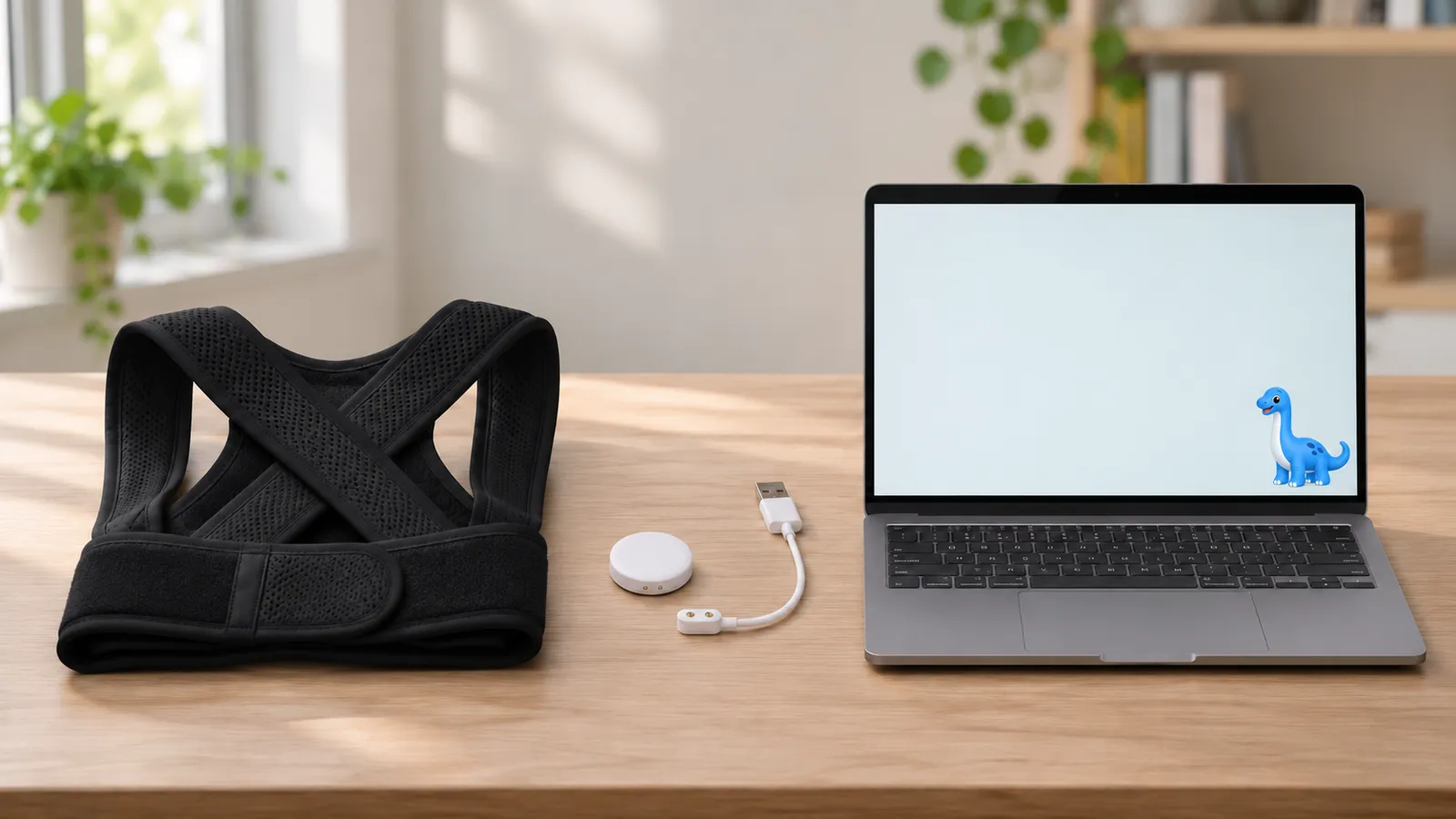
- These are three different things. A corrector (brace, strap, shirt) holds your shoulders back. A wearable like Upright Go buzzes when you slouch. An app watches through the camera and tells you.
- Correctors change your posture while you wear them. The evidence that they reduce pain is weak, and the reviews say so.
- Wearables and apps work the same way: feedback. In the trials, feedback keeps your neck a few degrees straighter for as long as it’s on.
- The difference between a wearable and an app is what you have to do every day: stick on, charge, and remember a sensor, or nothing.
- The feature with the best pain evidence isn’t in any corrector: a prompt to stand up and move.
“Posture corrector” is one search term that covers three products that don’t work the same way. One pulls you into position, one taps you on the back, one looks at you. They’re sold with similar claims, so this post sorts them by what they actually do, what the trials found, and what each one asks of you on a Tuesday afternoon in week six.
The three, side by side
| Posture corrector (brace, strap, shirt) | Wearable sensor (Upright Go and similar) | Posture app (camera) | |
|---|---|---|---|
| How it works | Pulls shoulders back; some compress the upper back | Sensor stuck to your upper back vibrates when you slouch | Camera checks your posture; a nudge on screen |
| What it changes | Position, while worn | Awareness; you correct yourself | Awareness; you correct yourself |
| What you do daily | Put it on, take it off | Stick on, charge, pair, train 15 min | Nothing after setup |
| Works away from the desk | Yes | Yes | No |
| Evidence for posture change | Yes, while worn | Yes, while on | Same mechanism as the sensor trials |
| Evidence for less pain | Weak | Not measured long term | Not measured long term |
| Typical cost | $15–60 | About $60–100 depending on sales | Free to a few dollars a month |
Correctors: they move you, but that’s not the same as fixing you
A brace or a posture shirt does one thing well. It holds your shoulders back while it’s on, and you can feel it working. The research question is whether that’s useful.
A 2019 scoping review of posture-correcting shirts in the Scandinavian Journal of Pain found that the shirts do change posture and people wearing them report feeling better, but the studies were small and low quality, and the review concluded the evidence didn’t support using them to manage pain. A 2023 comparison of three shoulder braces found all three reduced rounded-shoulder posture while worn. Its authors’ starting point was that conventional braces are bulky and uncomfortable, which is why people stop wearing them.
That’s the pattern. A corrector is a position, not a habit. Take it off and the muscles that were being held haven’t learned anything. Most physiotherapists who recommend one say the same thing: short periods, as a reminder of what upright feels like, alongside exercise. Not eight hours a day.
Wearables: feedback that works, with a daily cost
Upright Go is the best-known one: a small sensor you stick to your upper back with an adhesive, which vibrates when you slouch past the angle you calibrated. Upright’s site sells the Go 2 with a 15-minutes-a-day training plan, and it costs about $60–100 depending on sales.
The evidence for this kind of feedback is better than for braces, because it’s been tested with sensors in controlled conditions. In a study of healthy adults typing for an hour, people wearing a sensor that nudged them when they slouched held their necks 2.8° straighter than people without it. A 2025 systematic review of wearable posture devices found all eight included studies reported immediate improvements in alignment and awareness. A scoping review of sensor feedback during work tasks rated the evidence as “limited”: real, but from small, short experiments. None of them measured whether the change lasts after you take the sensor off.
So the feedback works. The question with a wearable is whether you’ll still be wearing it in March. It needs an adhesive or its necklace holder, a charge, a Bluetooth pairing, and a spot on your back under your clothes. That’s a small chore repeated daily, and the common failure with every posture product is the same: you stop using it. Our post on whether posture apps work goes through that failure mode in detail.
Apps: the same feedback, nothing to wear
A camera posture app does what the sensor does — notices you’ve slumped and tells you — without anything on your body. You calibrate once, and the app compares what it sees with that.
Two honest caveats. First, the controlled trials above used wearable sensors, not consumer apps; no consumer posture app has been through a trial that we know of. The mechanism is the same (notice, nudge, correct), but that’s an inference, not a measurement. Second, an app only works at the desk. If your slouching happens on the sofa or walking, a wearable follows you and an app doesn’t.
What an app can do that neither of the others can is combine the posture nudge with the one feature that has good pain evidence. The strongest trial on desk-work pain followed 193 office workers for six months: the group prompted to take short breaks or shift position through the day had about half the new neck pain of the group that wasn’t. That prompt isn’t in a brace or a sensor. It’s a timer, and most posture apps have one.
Which one, then
- You want your shoulders held back for an hour while you learn what upright feels like: a corrector, worn briefly, with exercise. Don’t expect it to fix pain.
- You slouch everywhere, not just at a desk, and you’ll keep a device charged and stuck on: a wearable.
- Your slouching is at a computer, and you want something you’ll still be using in three months because it asks nothing of you: an app, with the stand-up reminder turned on.
- You’re in pain now: none of these is the first step. The exercise trials for forward head posture and a physiotherapist are.
Where Slumpy fits
Slumpy is a posture reminder app for Mac, and it sits in the third row above. It checks your posture with a camera glance of a second or two every few minutes, compared against a calibration you set. A small dinosaur at the corner of your screen slouches when you do, and a gentle screen effect spreads until you sit up. No adhesive, no charging, nothing to wear; it runs quietly in the background and you forget it’s there until you slump. It also reminds you to stand, every 60 or 90 minutes, your choice (120 if you’d rather) — the step with the best evidence in this post. If a wearable sounds like one more thing to maintain, Slumpy is the version that doesn’t need maintaining.
Questions people ask
Are posture correctors effective?
They change your posture while you wear them, and people say they feel better in them. The reviews found the studies too small and low quality to say they reduce pain, and recommend short wear alongside exercise rather than all-day use.
How do I choose a posture corrector?
Pick for comfort and short sessions, not for strength. A brace you can’t stand for more than twenty minutes won’t get worn. If what you actually want is to stop slouching at a desk, a feedback device or app changes the habit; a brace only holds the position.
Is Upright Go worth it?
If you’ll wear it. The feedback it gives is the kind the trials support, and it works away from a desk. Its cost is the daily routine: adhesive, charging, pairing. If your slouching is mostly at a computer, an app gives the same feedback without the routine.
Can a posture app replace a posture corrector?
For desk slouching, yes, and it does more: it changes the habit instead of holding the position, and it can add the stand-up prompt that has the best pain evidence. For slouching away from a screen, a wearable or a brace is the only option.
Slumpy is a posture reminder app for Mac. It’s free on the Mac App Store — 3 hours of posture checks a day, no credit card, no account.
This article is general information, not medical advice. Prices are retailer listings as of November 2026. The studies are linked where they’re quoted; the figures are theirs.