
Forward head posture: why desk work causes it and what fixes it
By Dipanshu Goyal · · Updated
Short version
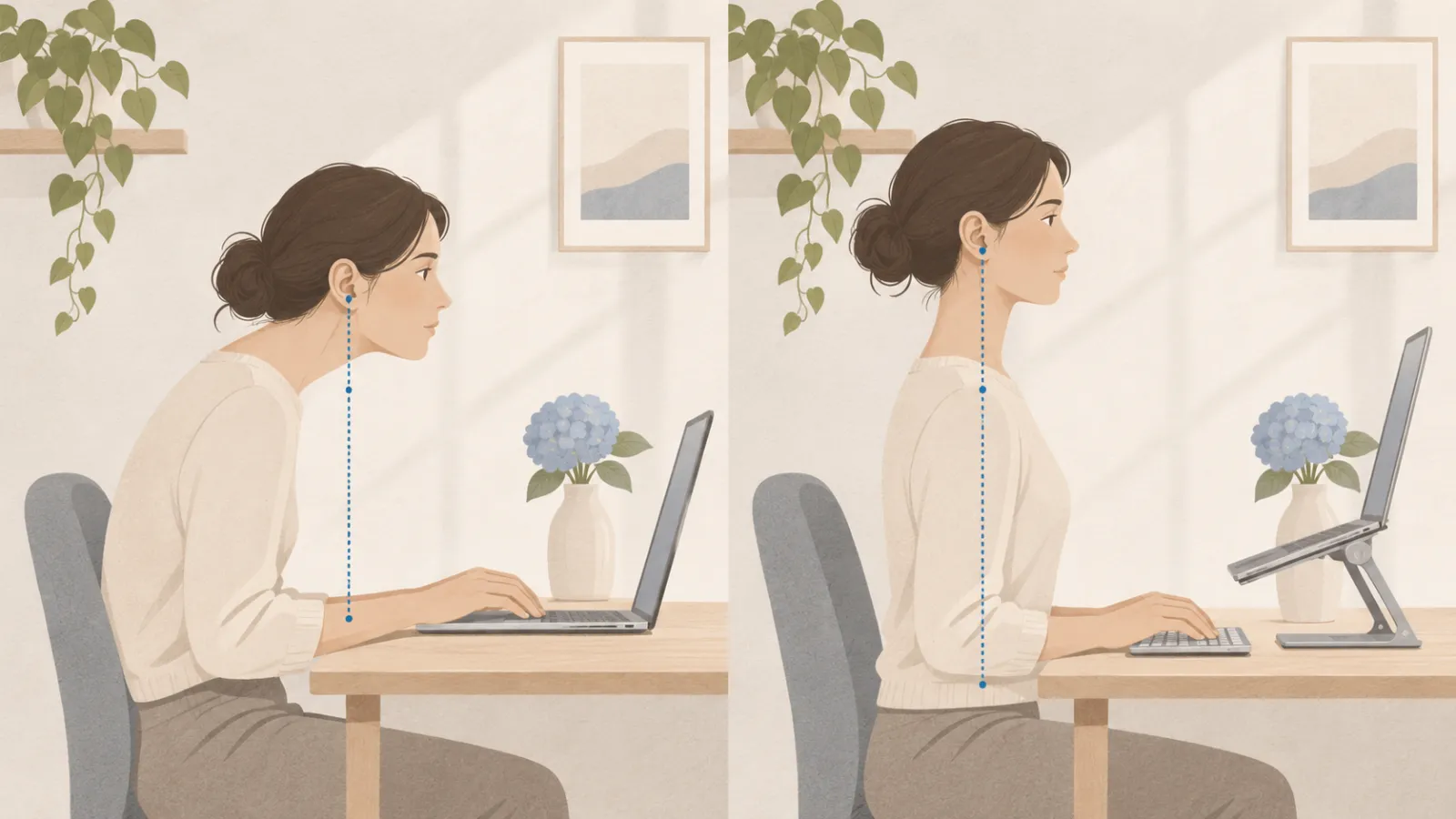
- Forward head posture is your head sitting in front of your shoulders instead of over them. Clinicians measure it as the craniovertebral angle: the smaller the angle, the further forward the head.
- Desk work causes it mechanically. A screen that’s too low or too far pulls the chin forward; after an hour of focused work almost everyone drifts.
- It is linked to neck pain in adults. People with neck pain tend to have more forward head posture, and the further forward, the worse the pain. The link is a correlation, not a one-way cause, and it doesn’t show up in teenagers.
- It is fixable. Across ten randomised trials, exercise programmes improved the angle by about 3.4° and reduced pain; the ones that combined neck and shoulder-blade work and ran eight weeks or more did best.
- It comes back if the desk stays the same. Raise the screen to eye level, then use a reminder for the drift you don’t notice — in lab tests, feedback alone cut neck bend by nearly 3° over an hour of typing.
If you’ve ever caught your reflection in a dark monitor and seen your chin out in front of your chest, you’ve seen forward head posture. It’s the most common posture complaint among people who work at a screen. It’s also the one with the clearest story: what causes it, what it’s linked to, and what fixes it are all reasonably well studied. Here’s that story without the “text neck” drama.
What forward head posture is
Stand sideways to a mirror. In a neutral posture, your ear sits roughly above your shoulder. In forward head posture it sits in front of it. The head has moved forward on the neck, the upper neck tips back to keep the eyes level, and the upper back often rounds to go with it.
Physiotherapists measure this with the craniovertebral angle — the angle between a horizontal line through the C7 vertebra (the bump at the base of your neck) and a line from there to the ear. A smaller angle means a more forward head. That number is what the studies below use, so when you see “the angle improved by 3°”, that’s the head moving back toward the shoulders.
Why desk work causes it
It isn’t weakness or laziness; it’s geometry plus time.
- The screen is low. A laptop screen on a desk sits well below eye level. Your eyes go to the screen and your head follows them down and forward. OSHA’s guidance is that the top of the screen should be at or just below eye level. The full set of numbers is in How to sit at a computer.
- The screen is far, or the text is small. You lean in to read, and the lean is all head and neck.
- Time. Even with a good setup, attention goes to the work and the head drifts. In a study of healthy adults doing an hour of typing, people held their necks measurably more bent without a reminder than with one, at every point in the hour.
The result is a head that weighs the same but hangs further from its support, so the muscles at the back of the neck work continuously to hold it. That’s the “tired neck at 5 p.m.” feeling. On a laptop it’s worse, and why a laptop makes your neck hurt explains it. The shoulders round with the head, and the ache that settles between the shoulder blades is covered in why your upper back hurts at a computer.
Does it actually cause neck pain?
Here the honest answer is “linked, not proven to cause”. A 2019 systematic review and meta-analysis of 15 studies found that adults with neck pain have more forward head posture than people without it. It also found that the further forward the head, the higher the pain intensity and disability (correlation −0.55 and −0.42). In adolescents, no such link. A 2023 meta-analysis found the same direction: a craniovertebral angle about 3° smaller in people with neck pain.
Two caveats, both of which matter for what you do about it. First, these are cross-sectional studies: they can’t say whether the posture caused the pain or the pain changed the posture. Second, not every study finds a difference. A 2023 University of Haifa study of 43 adults found essentially the same angle in people with and without neck pain. The sensible reading: forward head posture is a reasonable thing to fix if your neck hurts, not a diagnosis on its own. The rest of the picture (how long you sit still, how strong the neck and shoulders are) matters as much. We went through the wider posture–pain evidence in How to stop slouching at your desk.
What fixes it: the exercise evidence
This is the good news. Forward head posture responds to exercise better than most posture complaints, and the trials are reasonably consistent.
A 2026 meta-analysis of ten randomised trials covered 550 people with forward head posture and neck pain. Therapeutic exercise improved the craniovertebral angle by a mean of 3.38° compared with controls, and reduced pain intensity by about 1.4 points on a 10-point scale. Programmes that combined approaches and ran at least eight weeks tended to do better, with the overall certainty rated low to moderate. An earlier 2018 meta-analysis reached the same conclusion for the angle itself.
The programmes in those trials share three ingredients:
- Deep neck flexor work — the “chin tuck”: draw the chin straight back (not down) as if making a double chin, hold a few seconds, release. This trains the small muscles at the front of the neck that pull the head back over the shoulders.
- Shoulder-blade (scapular) strengthening — rows, scapular squeezes, the kind of pulling exercise that draws the shoulder blades back and down. Trials that added scapular stabilisation to neck work did better than neck work alone.
- Stretching the front — chest and the muscles at the back of the neck that have shortened to hold the head up.
Three or four short sessions a week for eight weeks is the pattern the trials used. If you have ongoing pain, a physiotherapist should set the programme; the above is what the research-backed programmes contain, not a prescription.
Why it comes back, and what to do about that
Exercise moves the head back. The desk moves it forward again, every day, for eight hours. If you fix the muscles and leave the setup, you’re training against your own desk.
So the order is: screen first, then reminders, then exercise.
- Screen at eye level. This takes away most of the mechanical reason for the drift. On a laptop that means a stand and a separate keyboard; the numbers are in the sitting guide.
- A reminder for the drift you don’t notice. Even with the screen right, people slump forward during focused work without noticing. In the typing study above, the same people held their neck 2.8° less flexed on average across an hour of typing with a posture sensor that nudged them than without it. That’s a different measurement from the craniovertebral angle the exercise trials use, so the two aren’t directly comparable. The lesson is the same, though: a reminder gets you a few degrees today, for as long as it’s on, while the exercise builds the change over weeks. What the trials say about posture feedback goes into this.
- Exercise to make it stick. The muscles then hold the position the reminder keeps putting you back in.
Where Slumpy fits
Slumpy is a posture reminder app for Mac built for the second step. You calibrate it once to how you sit when your head is where it should be. Then it takes a camera look of a second or two every few minutes. When your head has drifted forward and down, a small dinosaur slouches with you and a gentle screen effect spreads until you sit back, then clears. It notices head tilt separately from slouching, and it reminds you to stand — every 60 or 90 minutes, your choice. The camera is off between checks and nothing is recorded. If forward head posture is your specific complaint, this is the app’s main job.
Questions people ask
Can forward head posture be corrected?
Yes. Across ten randomised trials, exercise programmes improved the head position by about 3.4° and reduced neck pain, with eight-week programmes combining neck and shoulder-blade work doing best. Fixing the screen height stops it returning.
What is the best exercise for forward head posture?
No single one — the trials used combinations. The three ingredients are chin tucks (deep neck flexors), shoulder-blade strengthening such as rows, and stretching the chest and the back of the neck. Combined programmes beat any one of them alone.
Does forward head posture cause neck pain?
It’s linked to neck pain in adults: people with neck pain tend to have more forward head posture, and more of it means more pain. Whether it causes the pain or results from it isn’t settled, and the link doesn’t appear in teenagers. It’s worth correcting if your neck hurts, alongside moving more and strengthening.
How long does it take to fix forward head posture?
The trials that showed the clearest improvement ran eight weeks or longer, three or four sessions a week. You’ll sit differently immediately with the screen raised and a reminder on; the muscle change takes the weeks. For the habit and pain timelines too, see how long posture takes to fix.
Does a laptop cause forward head posture?
A laptop on a desk puts the screen well below eye level, which pulls the head forward and down to look at it. Raising it on a stand and using a separate keyboard is the single biggest fix for laptop users. Full laptop setup: Laptop posture.
Slumpy is a posture reminder app for Mac. It’s free on the Mac App Store — 3 hours of posture checks a day, no credit card, no account.
This article summarises published research and is not medical advice. If you have persistent neck pain, see a physiotherapist or doctor.