
How long does it take to fix your posture? Four timelines from the studies
By Dipanshu Goyal · · Updated
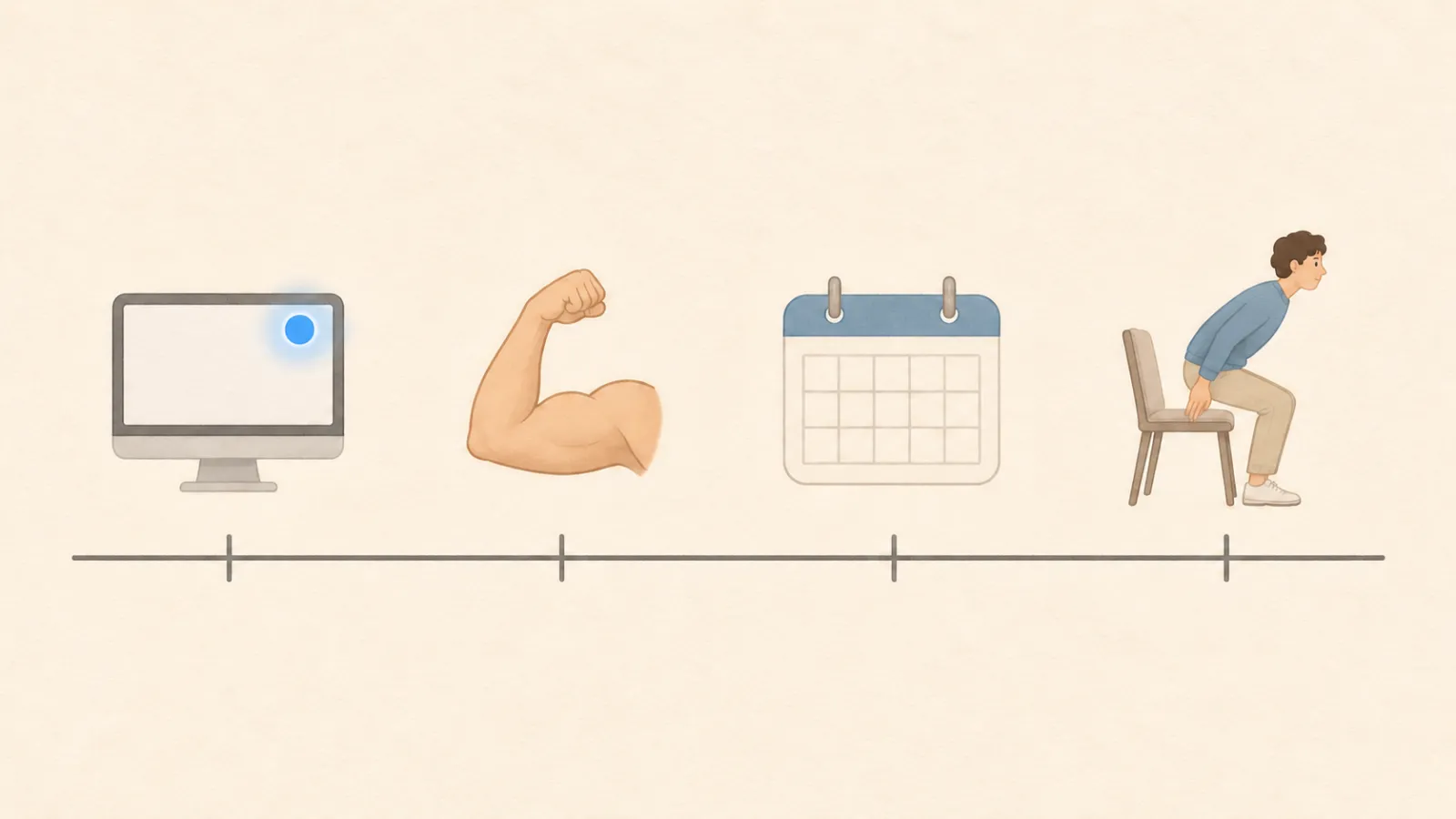
Short version
- The first change takes minutes, not months. With something reminding you, you sit with your neck a few degrees less bent within the first hour — and it stays that way for as long as the reminder is on.
- Muscles take about eight weeks. Exercise programmes that moved the head back over the shoulders ran eight weeks or longer, three or four short sessions a week.
- The habit takes about two months, with a wide range. In the best-known study of real-world habits, the median was 66 days to automatic — but anyone from 18 to 254 — and everyone tied the behaviour to the same daily cue.
- Pain is the slowest. The trial that roughly halved new neck pain in office workers ran six months, and what it changed was how often people moved, not how they sat.
- Shortcut: fix the screen height today, use a reminder from day one, and start the exercises — the three timelines run in parallel, not one after another.
“How long does it take to fix posture?” gets a different answer depending on what you mean by “fix”. Sitting differently today? Hours. Muscles that hold you there? Weeks. Not having to think about it? Months. Less neck pain? Longer, and by a different route than most people expect. The studies give a reasonably clear number for each, so here they are in order, with what you can do to shorten each one.
Timeline 1 — Minutes: sitting differently with a reminder on
The fastest change is the one most “fix your posture” articles skip. In a study of healthy adults typing for an hour, the people wearing a sensor that nudged them when they slouched held their neck 2.8° less bent on average than without it. The gap was there at every checkpoint through the hour: 56.6° versus 60.3° at minute 55. A 2025 review of wearable posture devices found the same across all eight studies it included: immediate improvement in alignment and awareness.
So on day one, with a reminder running, you already sit better. The catch, covered in Do posture apps actually work?, is that nobody has measured whether the change survives switching the reminder off. The longest of those studies ran four weeks. Treat the reminder as something you keep, not a course you finish.
How to shorten it: there’s nothing to shorten. Install a reminder and the first timeline is done.
Timeline 2 — Eight weeks: the muscles
A head that sits forward is held there by muscles that have adapted to it. Exercise changes that, and the trials are consistent about how long it takes. A 2026 meta-analysis of ten randomised trials covered 550 people with forward head posture. Exercise moved the head back by a mean 3.38° on the craniovertebral angle and cut pain by about 1.4 points out of 10. The programmes that did best combined neck and shoulder-blade work and ran eight weeks or longer. An earlier meta-analysis of seven trials reached the same conclusion on the angle. For neck pain specifically, workplace strengthening of the neck and shoulders, a few minutes a few times a week, reduced neck pain in office workers who had it.
What those programmes contain, and how to do them, is in Forward head posture: why desk work causes it and what fixes it.
How to shorten it: you can’t rush muscle, but you can stop undoing it. Eight weeks of exercise against a screen that pulls your head forward eight hours a day is a slow fight. Fix the screen so the exercise isn’t competing with the desk; the numbers are here.
Timeline 3 — About two months: the habit
The question people usually mean is “when will I sit up without thinking about it?” The best real-world data on habit formation comes from a study where people repeated a small daily behaviour in the same context for 12 weeks and recorded how automatic it felt. The median time to reach peak automaticity was 66 days; the range was 18 to 254; and missing a single day made little difference. Everyone in the study tied the behaviour to the same daily cue, and the people who repeated it most consistently showed the clearest habit curve: the same trigger, every time, repeated.
That’s the problem with posture as a habit. There’s no natural cue. You don’t slouch on purpose; you drift while your attention is on the work, so there’s no moment where “remember to sit up” fires. The reminder supplies the cue — the same nudge, every time you’ve slumped — which is exactly the condition the habit study found matters.
How to shorten it: make the cue automatic rather than scheduled. A timer going off while you’re already sitting fine teaches you to dismiss timers. A nudge that arrives when you’ve actually slumped pairs the cue with the behaviour, which is what builds the association.
Timeline 4 — Six months: pain
If the reason you’re asking is a sore neck, the honest timeline is the longest, and the route is different. The clearest trial on desk-work pain followed 193 office workers for six months. The group prompted to take short active breaks or shift posture had roughly half the rate of new neck pain of the control group. Note what the intervention was — moving more often, not sitting straighter. Posture feedback devices, by contrast, show no or mixed effects on pain in the reviews.
Two things follow. First, the stand-up reminder is the feature with the best pain evidence, so whatever posture app you use, use that part of it. Second, if the pain is already there, add the strengthening from timeline 2 and see a physio; a reminder is a cue, not a treatment. The wider posture–pain evidence is in How to stop slouching at your desk.
How to shorten it: start the breaks today. Every 30–60 minutes is Cornell’s guidance; the trial’s prompts were built into the workstation, which is the same job a reminder app does.
The four timelines together
| What you want | How long | What does it |
|---|---|---|
| Sit better right now | Minutes | A reminder that’s on |
| Muscles that hold it | ~8 weeks | Neck + shoulder-blade exercise, 3–4× a week |
| Sit up without thinking | ~2 months (18–254 days) | A consistent cue, every time |
| Less neck pain | ~6 months | Moving more often; strengthening if it already hurts |
They run in parallel. Day one you set the screen up, install a reminder and do the first session of exercises. Week eight the muscles have changed. Somewhere around month two it’s automatic. By month six you’ve been moving every hour for long enough that the pain trial’s effect has had time to show.
Where Slumpy fits
Slumpy is a posture reminder app for Mac, and it’s built for timelines 1 and 3 — the ones a reminder can actually shorten. It checks your posture with a camera glance of a second or two every few minutes, camera off in between. When you’ve slumped, a small dinosaur slouches with you and a gentle screen effect spreads until you sit up. That’s the “cue every time you’ve actually slumped” the habit research asks for, rather than a timer you learn to ignore. It also reminds you to stand — every 60 or 90 minutes, your choice — which is the part with the pain evidence behind it.
My own timeline, for what one person’s is worth: I’ve used Slumpy every working day for about three months. Sitting differently was immediate. Somewhere in the second month I noticed I was sitting up before the nudge, not after. That’s one person, and I built it — but it’s roughly what the numbers above would predict.
Questions people ask
Can you fix your posture in a week?
You can sit differently within an hour of having a reminder on, and a week is enough to notice you’re catching yourself. The muscle change takes about eight weeks and the habit about two months, so a week is a good start, not the finish.
How long does it take to correct forward head posture?
The trials that improved it ran eight weeks or longer, with three or four short exercise sessions a week combining chin tucks, shoulder-blade strengthening and stretching. Raising the screen to eye level stops it coming back.
How long until good posture becomes a habit?
Around two months on the best real-world habit data (median 66 days, range 18–254). Everyone in the study tied the habit to the same daily cue, and consistent repetition went with a clearer habit curve. That’s why we think a reminder that fires when you’ve actually slumped works better than one on a timer.
Does fixing posture reduce neck pain, and how fast?
The strongest evidence for less neck pain at a desk is for moving more often — a six-month trial roughly halved new neck pain with prompted breaks. Strengthening exercise helps existing pain over weeks. Sitting straighter on its own has weaker evidence; see a physio if pain is ongoing.
Slumpy is a posture reminder app for Mac. It’s free on the Mac App Store — 3 hours of posture checks a day, no credit card, no account. What the free plan includes.
This article summarises published research and is not medical advice; if you have persistent pain, see a clinician.