
Do posture apps actually work? What the studies say
By Dipanshu Goyal · · Updated
Short version
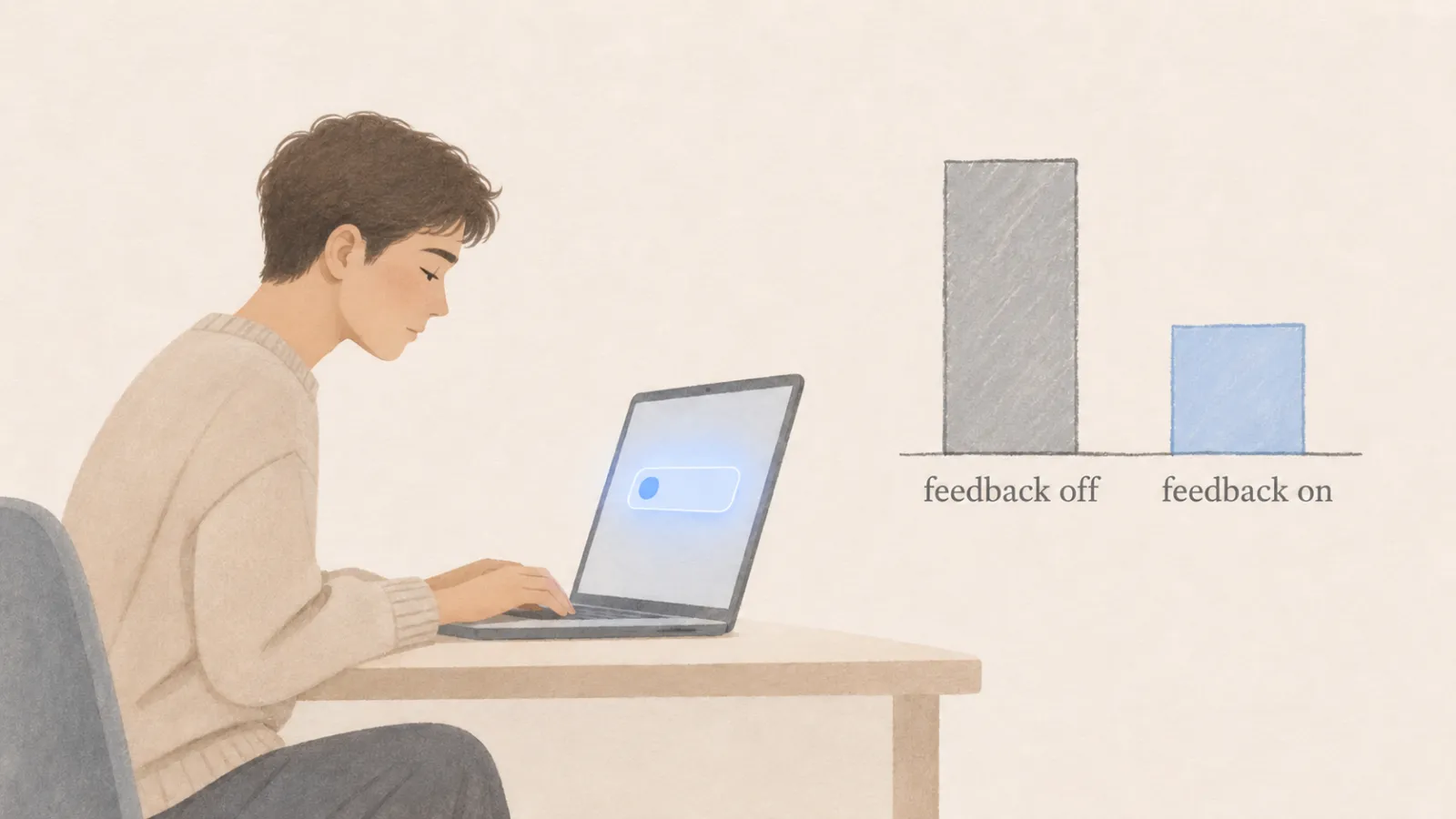
- Yes — while they’re running, which is the whole point of an app. In controlled tests, people with posture feedback on sat with their neck a few degrees less bent than without it, and the effect held for the full hour measured.
- Nobody has measured whether it lasts on its own. None of the studies in two recent reviews checked posture after the feedback was switched off. Read that the right way: the evidence is for feedback that stays on, which is what an app is.
- Pain is a different problem. A reminder changes how you sit; it isn’t a treatment. Reviews of feedback devices find no or mixed effects on pain, and the link between how you sit and whether you hurt is weaker than most people assume.
- The best-evidenced feature is a stand-up prompt. Break reminders on a work computer reliably cut long sitting stretches. A good posture app has one built in.
- The only way a reminder fails is if you stop using it. In a year-long trial, everyone given a buzzing posture tracker had stopped wearing it by month twelve. The one that works is the one you don’t turn off.
“Do posture apps work?” is really three questions: does feedback change how you sit right now, does the change stay when the feedback stops, and does any of it reduce pain? The evidence answers each differently, so it’s worth taking them one at a time. Most of the studies below are on wearable sensors clipped to the chest or back, not on Mac apps. We know of no consumer posture app, Slumpy included, that has been through a controlled trial. But the sensors do the same job an app does: notice slouching, nudge you. What the trials found about nudging applies.
1. While feedback is on, you sit differently — measurably
The cleanest test is a 2021 study from National Cheng Kung University in Taiwan. Twenty-one adults typed for an hour twice: once wearing a Lumo Lift sensor that vibrated when they slouched, once without. With the sensor, neck flexion was 2.8° lower on average and upper-back curvature 1.9° lower. The difference held at every checkpoint through the hour: at minute 55 it was 60.3° without the sensor versus 56.6° with it.
That 2.8° is worth putting beside the exercise evidence: the eight-week programmes for forward head posture move the head back by a few degrees too, over weeks rather than within the hour.
That pattern repeats across the literature. A 2025 systematic review of wearable posture-correction devices found that all eight included studies reported immediate improvements in alignment and body awareness. A scoping review of feedback from inertial sensors during work tasks rated the evidence for posture improvement as “limited” across fourteen studies — real, but from small, short experiments.
So the first answer is yes: when something tells you you’re slouching, you slouch less, by a few degrees, for as long as it keeps telling you. A few degrees doesn’t sound like much; it’s the size of change these sensors can measure reliably, and it was consistent.
2. Does it stick after the feedback stops? The studies haven’t looked
This is the question people actually care about — “will the app fix my posture?” — and it’s the one with the least evidence. The scoping review notes that none of its fourteen studies measured whether improvements were retained once feedback ended. The 2025 review says the same: none of its studies had extended follow-up, and the longest lasted four weeks.
The closest thing to a long test is discouraging. The ELF trial gave 130 healthcare workers at 19 sites a pager-sized sensor that beeped when they bent forward past a threshold. The comparison group got a sham version that recorded but stayed silent. At one week, the feedback group had changed by −0.7 threshold crossings and the sham group by −0.3, a difference of essentially zero. The authors’ conclusion: the audio feedback “did not reduce the number of times healthcare workers exceeded the postural threshold”. Lifting and bending at work is a harder target than sitting at a desk, but it’s the only sham-controlled trial of real-world posture feedback we found, and it found nothing.
The honest reading: feedback is a prompt, not a course you graduate from. It works like a spell-checker — useful every day, as long as it’s on. Nobody uninstalls the spell-checker because it hasn’t taught them to spell.
3. Pain: a different problem
The scoping review’s summary on pain is blunt: “no improvements in pain” across the studies that measured it, including one where neck pain went up during the computer task. The 2025 review found mixed results: about two points of relief on a ten-point scale in one study, a significant reduction in another, an increase in a third. It calls the lumbar reductions “small in magnitude.”
Part of the reason is that the posture–pain link itself is looser than the “sit up straight” advice implies. We went through that evidence in How to stop slouching at your desk. If your goal is less neck or back pain, a posture app is one input alongside movement and strength. The reminder helps you do the sitting part right, and a physio handles the rest.
4. The feature with the best evidence: a stand-up prompt
The best-supported thing a desk app can do isn’t posture detection at all. It’s interrupting long sitting.
In a randomised trial, office workers got a short education session, and some also got an on-screen prompt every 30 minutes telling them to stand up. The prompt cut long uninterrupted sitting periods more than education alone, even though total sitting time didn’t change significantly. A 2025 meta-analysis of 18 randomised trials (1,164 office workers) found that computer-prompt software reduced objectively measured workday sitting by about 12 minutes and added roughly 1,000 steps a day. The pooled change in total daily sitting was larger (−49 minutes) but not statistically significant.
Breaking up sitting is also the mechanism with the clearest health rationale: long unbroken bouts are what the sedentary-behaviour evidence keeps pointing at. A stand-up reminder is cheap and well-supported, which is why a good posture app builds one in rather than leaving it to a separate timer.
5. The real failure mode: you stop using it
The trial that should worry every posture-app maker is a 12-month Australian study. Office workers got either organisational support to sit less, or the same support plus a LUMOback posture tracker that buzzed on slouching and prolonged sitting. At 12 months the support-only group had cut workplace sitting by about 40 minutes per 10-hour day, and the tracker group had done no better. Not because feedback doesn’t work — because almost nobody kept the device on. Of the 61 workers given a tracker, 43 ever used it. Those with usable data wore it a mean of 12 days in the first 12 weeks, and by month twelve, every remaining participant had stopped. Reasons given included technical trouble and no time to set it up.
The Taiwanese authors saw the same thing coming: some participants said they’d turn the vibration off in a longer study. The paper notes vibration feedback is “noticeable but disturbing.”
This is the practical answer to “do posture apps work”: a posture reminder works exactly as long as you leave it running. The question to ask is whether you’ll still have it on in week six. Anything that nags, drains your battery or makes you feel watched gets switched off. If feeling watched is the worry, here is how to check what a camera app actually does. Something quiet that you forget is there keeps working.
What this means when you pick one
- Judge it on whether you’ll keep it on, not on how clever the detection is. Quiet feedback you can tolerate all day beats precise feedback you’ll disable by Friday.
- Make sure it has a stand-up reminder, and use it. That’s the part with trial evidence.
- Expect better sitting while it runs, not a permanent fix. If you want the habit to stick without the app, pair it with the things that actually build posture — strength work and a screen at eye height — covered in the slouching guide.
- Treat it as a reminder, not a treatment. If pain is the problem, use it alongside a physio, not instead of one.
Where Slumpy fits
Every finding above argues for the same design: feedback gentle enough that you keep it on, plus a stand-up reminder. That’s what Slumpy is. It checks your posture with a camera glance of a second or two every few minutes rather than watching continuously, so the camera light is off almost all the time and the battery cost is small. When you slouch, a small dinosaur slumps with you and a soft screen effect spreads until you sit up, then clears on its own — nothing to click away, and it never takes keyboard focus. It reminds you to stand every 90 minutes. It’s built to still be running in week six, which the studies say is the only thing that matters.
My own experience, for what one person’s is worth: I’ve used Slumpy every working day for about three months, since the first builds. I now sit up without thinking, because I know I’ll be nudged if I don’t — which is the “while it’s on” effect the studies describe. What I didn’t expect is that it carried over: my standing posture and my forward-head habit have improved, and my neck pain after a long working day has reduced significantly. The biggest change is simply being aware of my posture at all. That’s one person, not evidence, and I built the thing — but it’s the honest answer to “does it work for you?”
Questions people ask
Do posture reminder devices work?
While the feedback is on, yes: in a controlled test, people typing for an hour with a posture sensor held their neck 2.8° less bent than without it. The feature with the best evidence is the simplest one, a prompt to stand up, which reliably cuts long stretches of sitting. The common way they fail is that people stop using them; in a year-long trial, everyone given a posture tracker had stopped wearing it by month twelve. A posture reminder app for Mac does the reminding without a wearable.
Do posture correctors and wearables work?
While you’re wearing one and the feedback is on, yes — studies show a few degrees less neck and upper-back bend over an hour of typing. Whether the improvement lasts after you take it off hasn’t been measured, so pick one you’ll keep wearing — or an app, which you don’t have to wear. How braces, wearables like Upright Go and apps compare is in posture app vs posture corrector.
Do posture apps reduce back or neck pain?
The reviews find small or mixed effects: one reported “no improvements in pain” across its studies, another found reductions in some and not others. A posture app helps with the sitting part; movement and strength do the rest.
How long does it take for a posture app to change your habits?
The change in how you sit is immediate — the studies measured it within the first hour — and it lasts as long as the reminder is on. The longest studies ran four weeks, so nobody has measured what happens months later; treat an app as an ongoing reminder rather than a course you finish. The full timelines are in How long does it take to fix your posture?.
Is a break timer better than a posture app?
For the evidence available today, a prompt to stand up every 30 minutes or so is the better-supported feature. You don’t have to choose: a good posture app includes a stand-up reminder, so you get the posture feedback and the break prompt from one app. The four kinds of posture reminder, timers included, are compared side by side.
Slumpy is a posture reminder app for Mac. It’s free on the Mac App Store — 3 hours of posture checks a day, no credit card, no account. What the free plan includes.
This article summarises published research and is not medical advice; if you have persistent pain, see a clinician.