
Webcam posture apps and privacy: five things to check
By Dipanshu Goyal · · Updated
Short version
- A posture app is not a video call. You’re giving a program your camera for the whole working day, so the questions are different: how often is the camera actually on, what leaves the Mac, and is any picture ever saved?
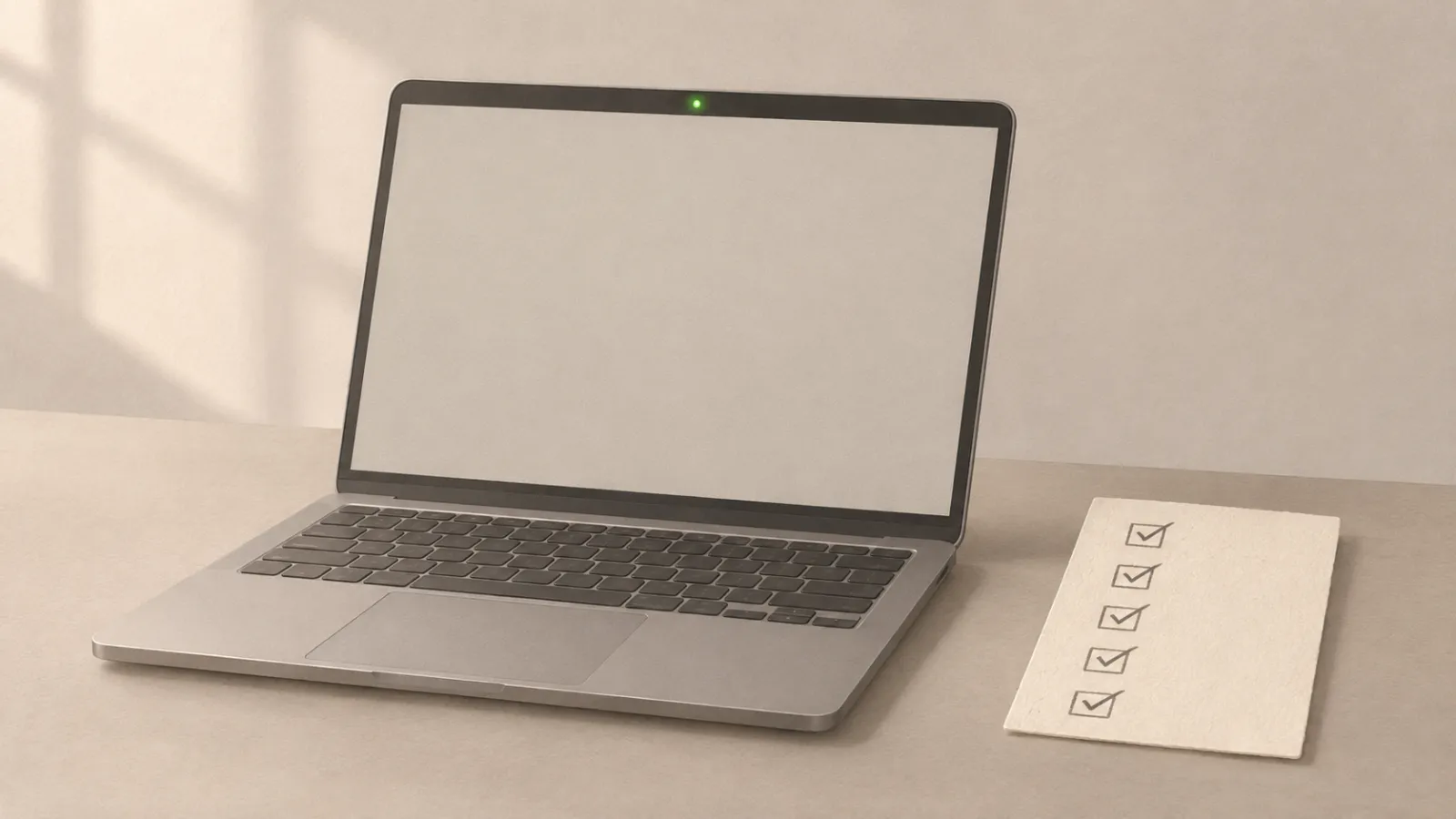
- Your Mac tells you the first one. Apple designs the built-in camera so it can’t turn on without the green light. If the light is on all day, the app is watching all day; if it blinks for a second or two now and then, that’s how often it looks.
- The App Store privacy label tells you the second one — partly. It’s filled in by the developer, required, and not audited. “Data Not Collected” is the strongest label; “Data Linked to You” means the app ties data to your account or device.
- No label tells you whether frames are saved on your Mac. Only the privacy policy does, if the developer bothered to say. Look for a plain sentence like “no image, frame or video is written to disk.”
- You can check all of it yourself in five minutes: the light, the label, the policy, whether an account is required, and the Camera list in System Settings.
- An app can pass all five. Slumpy does: a blinking light instead of a steady one, a “Data Not Collected” label, a policy that says in plain words nothing is saved, and no account. The end of this post shows you how to confirm each one yourself.
Most of the advice about webcam privacy is about video calls: cover the lens, check who’s on the call. A posture app is a different situation. You install it once, grant camera access once, and it has your camera for eight hours a day, every day, in your home. Trusting that deserves a few specific questions rather than a reassuring word like “on-device”. Here are the five that matter, what Apple’s own documentation says about each, and how to check them. Whether posture apps are worth running at all is a separate question, covered in what the studies say about posture apps.
1. How often is the camera really on?
There are two kinds of webcam posture app. One keeps the camera running continuously and judges every frame. The other turns the camera on for a moment, looks, and turns it off again. Both can be called “on-device”; they are not the same thing to live with.
The honest signal is the light. Apple’s support page says the camera “is engineered so that it can’t activate without the camera indicator light also turning on”. On the MacBook Neo, Apple’s platform security guide says the on-screen indicator is designed to prevent any untrusted software — even with root or kernel privileges — from engaging the camera without visibly lighting it. That covers the built-in camera; an external webcam’s light is the webcam maker’s job, and some have none. So watch the light for ten minutes after you install a posture app:
- Steady green all day — the camera is on all day. Fine if you’ve accepted that; just know it.
- A brief flash every few minutes — the app looks occasionally and is off in between.
- Nothing — the app isn’t using the camera (AirPods-based apps, or a timer).
An app’s marketing may say “lightweight” or “private”; the light says what it actually does.
2. What leaves your Mac? Read the label, then read it carefully
Every app on the Mac App Store carries a privacy label, in three tiers. Apple’s definitions: data “linked to you” is collected in a way tied to your identity — your account, your device, or details like a phone number. To claim data is “not linked”, the developer has to strip identifiers before collection and not re-link it afterwards. “Data Not Collected” means the developer collects nothing at all.
Two things to know about labels. First, they’re self-reported. Apple’s developer guidance says the developer fills in the answers in App Store Connect and must keep them accurate, and the label is required to submit an app. Apple requires the label but, as the authors of a 2024 study put it, does not validate it. That study ran language models over the privacy policies of 474,669 iOS apps. About 228,000 policies appeared to describe more user-linked data collection than the app’s label declared, and 97% of apps labelled “Data Not Collected” had a policy indicating otherwise. The label is a declaration, not a measurement. Second, a label is about collection by the developer. An app with “Data Not Collected” can still be a continuous-camera app; the label says nothing about how often the lens is on.
Here is what the labels say for the Mac posture apps we track, as checked on the US App Store on 13 November 2026 (labels change; re-check before you rely on this):
| App | How it watches | Privacy label (13 Nov 2026) |
|---|---|---|
| Slumpy | Webcam, checks of a second or two every few minutes | Data Not Collected |
| SitApp | Webcam, continuous | Data Linked to You — email, purchase history, user and device IDs, product interaction, diagnostics |
| Posture Reminder AI | Webcam, runs in the background (on-time not stated) | Data Not Collected |
| SitWit (Posture Monitoring: MacPosture) | Webcam, continuous | Data Not Linked to You — device ID, product interaction, crash data |
| Dorso (formerly Posturr) | Webcam or AirPods | Data Not Collected |
| Posture Monitor | Webcam, continuous | Data Not Collected |
| Nekoze | Webcam, continuous | Data Not Collected |
| Posture Pal | AirPods motion sensors, no camera | Data Not Linked to You — product interaction |
Notice what the one “Linked to You” label lists: email and purchase history. That’s what an account gives a developer to link data to, which is question four.
3. Is any image or frame ever saved?
This is the question the label can’t answer, and it’s the one people are really asking. “Processed on-device” means the analysis happens on your Mac. It does not by itself mean nothing is stored on your Mac. An app could, in principle, keep calibration photos, write frames to a log, or attach a screenshot to a crash report, all without “collecting” anything in Apple’s sense.
The only place to find out is the privacy policy, and the test is whether it says something concrete. A good policy answers in plain words: whether any image or frame is written to disk, whether anything is transmitted, and what a “send feedback” or “share diagnostics” button actually attaches. If the policy only says “we take your privacy seriously” and “data is processed locally”, it hasn’t answered.
4. Does it need an account?
An account means an email address, usually a purchase record, and an ID the developer can tie the rest to. That’s not sinister; it’s how cross-platform licences and cloud features work. But for a camera app it’s worth noticing, because it’s exactly what turns “Data Not Collected” into “Data Linked to You”. If an app offers the same features with and without signing in, don’t sign in.
5. Check it yourself: five minutes
- The light. Watch it for ten minutes of normal work. Steady, blinking, or off.
- The label. On the App Store page, scroll to “App Privacy”. Note which tier and which data types.
- The policy. Search it for “image”, “frame”, “video”, “disk”, “upload”. You’re looking for an explicit “never”, not an absence.
- The account. If it asks you to sign up, ask what you get for it.
- The Camera list. System Settings › Privacy & Security › Camera lists every app that can use the camera, and you can turn access off per app at any time. Apple’s Mac guide also notes the camera and its light turn off when you quit every app that can use it — a quick way to confirm which app is holding it.
If you want to go one step further, use a firewall app that shows outgoing connections per app; Little Snitch and LuLu are the common ones. It will show you whether the posture app talks to the internet at all, and to whom. An app that collects nothing should make almost no connections — an occasional check for updates is normal.
What Slumpy does
Since labels are self-declared, a label alone shouldn’t convince you — the policy behind it should. So here is Slumpy’s answer to all five in plain words, taken from our privacy page where the full version lives:
- Camera: in Random posture checks, the camera turns on for a second or two at a time every few minutes and is off in between; you’ll see the light blink, not stay on. A Continuous mode exists if you prefer it.
- Label: Data Not Collected.
- Images: no image, frame or video is ever written to disk or transmitted. Detection turns what the camera sees into a few numbers about your posture, compares them with your calibration, and discards them. Calibration stores numbers describing your posture and a rough numeric description of what’s behind you (so setups can be told apart) — numbers, not a picture, on your Mac only.
- Account: none. No sign-in, no advertising identifier, no analytics in the app.
- Network: once a day it asks Apple’s public App Store service whether a newer version exists. That request names Slumpy and your region, nothing about you.
We’d rather you check than take our word for it: install it, watch the light blink once every few minutes, open the Camera list, and read the label. They’ll all say the same thing.
Questions people ask
Does a posture app record me?
It depends on the app, and the App Store label won’t tell you. Read the privacy policy for an explicit statement that no image, frame or video is written to disk or transmitted. If the policy doesn’t say, assume it might.
Can a Mac app use the camera without the green light?
For the built-in camera, Apple says no: Mac laptop cameras are engineered so the camera can’t activate without the indicator light, and on the MacBook Neo the indicator is designed to hold even against software with root or kernel privileges. The light is the most reliable privacy signal you have.
What does “Data Not Collected” mean on the App Store?
That the developer declares it collects no data from the app at all. It’s the strongest of the three label tiers, it’s self-reported, and it says nothing about how often the app uses the camera or whether anything is stored locally.
Which Mac posture apps don’t record video?
Of the eight we track, five carry “Data Not Collected” labels; SitApp’s label links email, purchases, IDs and usage to you, and SitWit’s and Posture Pal’s declare device or usage data not linked to you. Whether frames are stored locally is a separate question each app’s policy has to answer. The full comparison is in Best posture apps for Mac.
Is an AirPods posture app more private than a webcam one?
There’s no camera, which removes the biggest worry. The label still matters — Posture Pal, for example, declares product-interaction data not linked to you — and AirPods apps only see your head angle while you’re wearing them. The four approaches compared covers the trade-offs.
Slumpy is a posture reminder app for Mac. It’s free on the Mac App Store — 3 hours of posture checks a day, no credit card, no account.
Labels and app facts above were checked on 13 November 2026 and may have changed; Apple’s documentation is linked where quoted.